Climate Week 2026
What We Learned at Why Regenerative
Uptown & Boogie Healthy Project | September 21–25, 2026
Our Executive Director spent Climate Week in New York at the Why Regenerative sessions, plus a separate farm-to-school event hosted by the Plant Powered School Meals Coalition. Throughout the week, conversations covered soil health, food labeling, Indigenous agriculture, farm policy, and school food. We learned about Why Regenerative through a post Wolfe’s Neck Center shared in the Hudson Valley Young Farmers Coalition, which reminds us that the most useful information for small farmers still moves through farmer networks.
What follows is a day-by-day record of what was said, who said it, and the resources worth keeping. We are sharing it in full because the organizations and funding programs named here are useful to the farmers, vendors, and community partners we work with across Harlem and the Bronx.
Day 1, Monday, September 21
Regenerative Retail Lunch, Retail Forum, and afternoon talks
Quote of the day, from an audience member:
“It’s hard to be green when you’re in the red.”
Regenerative Retail Lunch
Speakers: Carolyn Gahn (Applegate), Leah Mann (Thrive Market), Nanyelis Diaz Chapman (Agricultural Platform Collective), Maddy Rotman (Painterland Sisters), Josh Broun (Impact Kitchen)
Josh Broun opened on how retailers and buyers can concretely support farmers. Carolyn Gahn followed with winter camellia seed: a crop planted after the fall harvest and brought in during spring, processed into oil that airlines use and into turkey feed. It is a cover crop with a market attached, which is a different economic proposition than a cover crop alone. Gahn connected nutrient density to both human health and soil health and argued that data lets consumers make informed choices.
Regenerative Retail Forum
Samual, a chestnut farmer at Green Leaf Farming, opened by describing a mistake: he planted wheat, and it overgrew and competed with his nut crop. Cover crop selection is not a checkbox, and the wrong cover becomes a competitor for water, light, and nutrients.
The panel took up how to help customers understand regenerative farming when it carries a higher price tag. Points raised included:
“Ag and nature are not a laboratory.”
- How do we keep the family farmer farming?
- Health and wellness is where consumer money is moving, which is the opening for this conversation.
- Watch for “health washing,” the nutrition version of greenwashing.
- What is actually driving the outcomes coming out of the soil?
Our ED asked the panel about nutrition and food safety as the next frontier: what the government actually allows producers to say, and how you tell the story of your standards when “better for you” has no legal definition. The responses:
- The nutrient density conversation began in 2003, as a conversation with farmers about the taste of food.
- Farmers who want to grow food for people should grow a variety of nutrient-dense crops.
- One panelist argued for retiring a familiar phrase: “Food is health instead of food is medicine.”
- Nutrient density messaging should give growers a roadmap to grow healthy food and build a nutritional profile, not just give marketers a claim.
Reginaldo Haslett-Marroquin, Regenerative Agriculture Alliance
He pointed to the Forest Stewardship Council as a model: understand a product’s full life cycle first, then build standards from it. He spoke on animal dignity and jungle-style habitat design, and on whole-supply-chain integration, describing a 5% livestock mortality rate against a 15% industry norm, using chickens as the example. On retail, his position was direct: pay the real price. He also noted the industry now has more scientists than farmers, and shared a Guatemalan saying:
“If you don’t know where you’re going, every bus will take you there.”
Steve Brown, Big Tree Farms Inc.
He spoke on vertical growing and on information as infrastructure. When asked where fertility comes from when feeding livestock without relying on fossil fuels, he said to build a micro-ecosystem and grow the feed locally.
Charlene Guzman, Non-GMO Project
Guzman framed her talk as a ten-year conversation on the processing gap:
- 80% of consumers ask questions about how their food is processed and what it means for their health.
- 72% of consumers do not know how to identify what is in their food.
- 60% want a Non-GMO label; 30% will pay extra for one.
- 70% of what children eat is processed food, which makes vegetables a harder sell.
Her clearest example: two products both list “rice flour,” and nothing on either package tells the shopper they were processed completely differently.
Our ED asked which labels a beginning farmer should actually pursue, given how crowded product labeling has become. Guzman agreed the overwhelm is real, but pushed back too: labels still matter, because if people do not see one, they will not buy. What shoppers want is a product they can trust.
Alicia Simmons, Frontier Co-op
Simmons walked through the yerba mate supply chain and its intercropping practices, and plainly named the funding problem: farmers face funding gaps, and no one has clearly answered who aggregates that process on their behalf. On what goes wrong, she was specific. You need committed suppliers and committed purchasers, with trust built deep enough that a loss does not break the system. Distributors have to hold up their end too.
A panelist in this session offered:
“Leave nature better off than where we found it.”
The conversation closed on what regenerative looks like five years out: farmers interacting, holding standards, building supply chains, and winning shelf placement, with retailers educated and sustainability teams working alongside sales teams. One panelist challenged “vote with your wallet” as a strategy, since people choose affordable options and affordable does not reliably mean healthiest. Another put it sharply:
“The absence of value; what we have left is price.”
The panel grounded regenerative in the Five Principles of Soil Health: minimize soil disturbance, keep soil covered, maintain living roots, maximize plant diversity, and integrate livestock. Those principles are the mechanics behind every claim a label compresses into one word.
Ideas raised for closing the consumer knowledge gap: monthly education for retail staff, social media education, in-store nutritionists who shop alongside customers, and bringing farmers back into visible roles in the food system.
Robbie Dye, Our Farms, closed with a Discovery food box program built so customers hear the story of the farm behind their food. He described the category manager’s job as storytelling: surfacing the data, knowing what makes a product distinct, and carrying its certifications forward.
Day 1 resources
- 2026 Regenerative Organic Nutrition Report, Edacious and the Regenerative Organic Alliance: edacious.com/2026-roc-nutrition-report (full product data at eat.edacious.com)
- Next Generation Farmer Fund, a $1 million+ initiative launched in August 2026 by Whole Foods Market and the National Young Farmers Coalition for beginning farmers: youngfarmers.org/get-involved/next-generation-farmer-fund/
- Zero Foodprint, grant program reopened October 1, 2026: zerofoodprint.org/apply
- Non-UPF Verified app, scans products for verification status: apps.apple.com/us/app/non-upf-verified/id6769893886
- Our Farms Discovery box program: community.ourfarms.com
- Whole Foods Market LEAP (Local and Emerging Accelerator Program) and its Early Growth track, training and resources for emerging brands entering retail
Day 2, Tuesday, September 22
Regenerative Systems Summit and Ag Policy Summit
Quote of the day, from Robert Loggins, Bush Brothers:
“My data is my cash crop.”
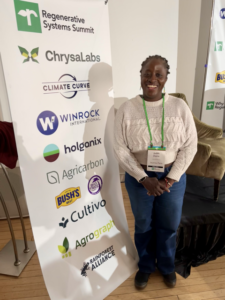
Regenerative Systems Summit
The morning focused on designing programs and the benefits they bring to providers and producers. The U.S. Farm Credit System and PepsiCo provide low-cost loans to those working in PepsiCo’s supply chain to purchase equipment.
The Regenerating Together Program, launched by the SAI Platform, is a global outcome-based initiative to standardize, measure, and verify regenerative agriculture practices across food supply chains.
Several figures framed the scale of the problem:
- One third of the world’s population does not have access to healthy food.
- The U.S. is buying 1 million carbon credits from India.
- The U.S. is roughly 10 years behind on forestry carbon.
The summit raised questions we are still sitting with: what are a farm’s biodiversity models, and which biodiversity practices are economically viable for farmers? The discussion covered sector challenges, current solutions, pest control, and the green finance gap, along with a proposal to bring chemical companies to the table to help move alternative solutions to market.
On agricultural expansion: converting natural ecosystems into farmland creates environmental, climate, and socioeconomic problems, disrupting global systems in several ways at once.
On water quality: water tests are showing at least five pesticides in a single sample. Agricultural runoff is a major problem.
Robert Loggins, Director of External Affairs and Community Engagement at Bush Brothers, spoke on sustainability in growth and profits.
Taralinda Willis, CEO of Agrograph, noted that Iowa cancer rates are high, and explained that a tile is a pipe running directly into a stream, which means we cannot tell what is in the water. She also noted that regenerative, as a practice model, is about ten years old.
Sara Farley, Vice President, Food Initiative, Rockefeller Foundation, led a conversation on farmer wellbeing and the Regen10 framework. Regen10 hosted a side event at the UNCCD COP17.
Also referenced: the Montreal Protocol, the global treaty signed September 16, 1987, to protect the ozone layer by banning the chemicals that destroy it, and the Global Methane Hub, which is building a network of scientists, experts, activists, policymakers, and philanthropists.
Ag Policy Summit, topic: label transparency
“We focus on fighting against and forget what we are fighting for.”
— Matthew Dominguez, Executive Director, Compassion in World Farming
Panelist Carrie Balkcom noted that “grass-fed and grass-finished” is the new label, and it is undefined with no regulation behind it.
Two pieces of legislation came up:
- The Save Our Bacon Act (H.R. 4673). This proposed federal measure would prohibit state and local governments from regulating livestock production practices in other states, primarily targeting voter-approved animal welfare laws like California’s Proposition 12.
- Farm inheritance legislation refers to federal and state measures on estate and inheritance taxes for agricultural land and machinery. The One Big Beautiful Bill Act (2025) permanently established a $15 million per-individual exemption starting in 2026. The federal HERITAGE Act proposes raising special-use valuation caps to $15 million to prevent land sales during generational transfers.
Alan Lewis, VP of Advocacy & Governmental Affairs at Natural Grocers, spoke on international farm groups and a report on what is not regenerative.
Karen Ross, Secretary of the California Department of Food and Agriculture, spoke on the state’s culinary program. The session also raised a statistic worth exploring further: 82% of voters support farmers.
Other threads from the day: what farmers actually think about regenerative farming, the return to Indigenous practice, and the need for a guidebook on regenerative agriculture. Nitrogen fertilizer production and application account for roughly 2% to 5% of global greenhouse gas emissions, with both a massive positive impact on global food supply and severe environmental consequences.
Also noted: Chef Spike Gjerde, who cooks with regenerative agriculture ingredients, and Richard Ball in the Finger Lakes region, working with Certified Naturally Grown, a farmer-to-farmer peer certification.
Day 2 resources
- SAI Platform, Regenerating Together Program: saiplatform.org/schemes-and-frameworks/regenerating-together-programme/
- Regen10 past meetings and recordings: regen10.org/past-meetings-and-recordings/
- Global Methane Hub: globalmethanehub.org
- Uproot Center: uprootcenter.org
- Certified Naturally Grown, peer-review certification for small farms
Terms worth knowing, defined
- Organic carbon projects: agricultural and land-management initiatives designed to capture atmospheric carbon dioxide and store it as soil organic carbon.
- Agricultural expansion: converting natural ecosystems into farmland, with cascading environmental, climate, and socioeconomic effects.
Day 3, Wednesday, September 23
Partnerships in Indigenous Agriculture, and The State of Regenerative Agriculture
Quote of the day, from Angela Ferguson:
“One seed can save humanity.”
Partnerships in Indigenous Agriculture
The session opened on CDFIs, described in the room as a bank with morals.
A projection that reframed the economics of Native agriculture: the agriculture and food sector in Indian Country could eventually surpass the tribal casino industry. That projection comes from “Reimagining Native Food Economies,” published by the Native American Agriculture Fund, the largest philanthropic organization dedicated entirely to serving Native American farmers and ranchers.
Michael Kotutwa Johnson, PhD, MPP, an expert on dry farming, spoke on seed sovereignty and pointed attendees toward seed savers, Baker Creek, and heritage seeds. His article “The Seed is the Law,” published in the UCLA Law Review, analyzes international and U.S. law on Indigenous heirloom seeds, traditional knowledge, and seed rematriation against Western intellectual property frameworks.
Angela Ferguson, a traditional corn grower from the Onondaga Nation and founder of Braiding the Sacred, spoke about the three sisters planting method, with corn as the main plant, and framed it as instruction for climate adaptation. Her charge to the room was to be proud of the seed you come from, which means being proud to say where you are from. She also described using an onion-and-garlic spray on plants.
This landed close to home for us. UBHP grows Haitian and Caribbean heritage crops, and the case for seed sovereignty is the same case we make at our markets every week.
On health outcomes: American Indian adults in South Dakota experience diabetes at roughly 23%, double the rate of white adults in the state. The USDA is reviving $32 million in food sovereignty funding. The session also covered bison population management and the bison’s role as a sacred animal and vital source of food and culture for Plains nations.
The State of Regenerative Agriculture
On the Farm Bill: $2 billion cut to conservation farming.
Several points reframed how we talk about this work:
- Stop using “conventional agriculture.” It is chemical agriculture.
- U.S. organic is only 1% of farms. Demand for organic is up, but the number of organic farms has not increased, so organic is being imported.
- Less than 1% of corn grown is grown for eating.
The call to action from this session:
- Change the way we talk about agriculture.
- Influence your organization’s supply chain where you can change it. Copenhagen, Denmark converted its government food system to regenerative agriculture.
- Lighthouse: regenerative meals in schools. 100 million children are without lunch.
Day 3 resources
- Native American Agriculture Fund: nativeamericanagriculturefund.org
- “Reimagining Native Food Economies,” NAAF
- “The Seed is the Law,” Dr. Michael Kotutwa Johnson, UCLA Law Review
- Braiding the Sacred, founded by Angela Ferguson
- Free the Seed: freetheseed.org
- Rodale Institute, Pennsylvania
Day 4, Thursday, September 24
At the Harlem farm stand
We did not attend Climate Week sessions on Thursday. Our Executive Director was running the Harlem farm stand and CSA distribution.
We are naming that deliberately. The tension between being in the room where food policy gets discussed and being at the stand where food actually changes hands is a real constraint for small organizations, and one reason the people most affected by these conversations are often absent from them. Conference weeks are built for people whose work can pause. Farm stands and CSA pickups cannot.
That is also what makes the Day 1 question about labeling, and the Day 3 call to change how we talk about agriculture, practical rather than abstract for us. Our answers get tested at the stand on Thursdays.
Day 5, Friday, September 25
“Climate Action Is On the Menu!” hosted by the Plant Powered School Meals Coalition
This session was not part of Why Regenerative. It was a separate Climate Week event hosted by the Plant Powered School Meals Coalition, focused on farm to school and built around the theme of plants on plates. We are including it here because it connects directly to UBHP’s work with young people in Harlem and the Bronx.
Amy Hamlin coined the framing of legume-full partnership and “plant power on the move,” citing a 42% reduction in carbon footprint per student.
Andrew Binovi presented a soy milk campaign addressing milk allergies and plant-based preference in school meals.
Allison Kingsley spoke on the premise that what we eat matters, and described organizing a free farmers market and a Mount Sinai farm box program for patients.
Sierra Hollowell described piloting Meatless Monday in Brooklyn, including work with Rachael Ray, and presented a Good Food Purchasing data report.
Yandel Ramírez, born and raised in the Bronx, spoke on advocating for healthy food access in the Bronx. We are following up to ask if he would join a future UBHP panel.
Emily Girón spoke on handling food safety and food poisoning.
Day 5 resources
- Plant Powered School Meals Coalition, host of “Climate Action Is On the Menu!”
- Good Food Purchasing Program data report, presented by Sierra Hollowell
What we are taking back
Across the four days we attended, the same conclusion kept surfacing from different directions: bringing trust back to food means bringing farmers back into visible roles in the system, at the register, on the label, and in the story a shopper hears before they buy.
That is not a new idea for UBHP. It is the model we have built from the start, at our markets, through our CSA, and on the ground at Joumou Farm.
Three practical things we are carrying forward:
- Document the practice before chasing the label. Certification follows the work. For the growers in our network, building the record now makes future certification reachable.
- Funding exists for beginning farmers right now. The Next Generation Farmer Fund and Zero Foodprint are both open or opening, and most of the farmers we work with have not heard of either.
- Seed sovereignty is food sovereignty. Angela Ferguson’s charge to be proud of the seed you come from is the clearest statement we have heard of why heritage crops matter, and why our markets exist.
Uptown & Boogie Healthy Project is a 501(c)(3) nonprofit operating farmers’ markets, a CSA, and food programs in Harlem and the Bronx. Learn more at ubhealthyproject.org/about.